

How Much Does a Small Business Website Really Cost in 2026?
Understanding Website Development, Hosting, Maintenance, and Long-Term Investment
Building a professional website is an important step toward establishing a credible online presence for your business.
But before starting, one question almost every business owner asks is:
How much does a professional business website actually cost?
If you’ve already researched website development services, you’ve probably noticed significant differences in pricing.
Some providers advertise affordable website packages, while others offer comprehensive development solutions requiring a much larger investment.
Why such a difference?
The answer lies in what each website is designed to accomplish, the services included, and the level of customization required.
A simple business information website is very different from a professionally developed platform with custom functionality, lead capture systems, or business integrations.
In this guide, we’ll explain the factors affecting website development costs in 2026, the expenses businesses should anticipate, and how to choose a solution that delivers long-term value.
How Much Does a Professional Business Website Cost in 2026?
Website development pricing varies depending on the project scope, technical requirements, design complexity, and experience of the development provider.
For businesses in the Philippines, published 2026 pricing guides show that simpler business websites can cost tens of thousands of pesos, while customized corporate websites and advanced digital platforms can require substantially larger investments.
The following ranges provide general planning references:
| Website Type | Indicative Philippine Budget |
|---|---|
| Starter or template-based website | ₱15,000–₱40,000 |
| Professional business website | ₱40,000–₱120,000 |
| Advanced corporate website | ₱120,000–₱300,000+ |
| E-commerce or custom-integrated website | ₱100,000–₱500,000+ |
These are broad market planning estimates, not ArdyOnline service rates or guaranteed quotations. There is no standardized industry price, and actual project costs may fall outside these ranges.
International businesses should also expect variations based on local market conditions, professional rates, technology, and development scope.
Rather than comparing price alone, business owners should understand what is included in a website development proposal.
1. Website Planning and Business Strategy
A professional website should begin with understanding the business it is intended to support.
Before development, the website provider should identify the company’s goals, target customers, required features, and intended user experience.
For example, a consulting business may need an informative website that encourages appointment requests.
A retail business might require a product catalog or online purchasing functionality.
Meanwhile, a service company may benefit from automated inquiries, appointment scheduling, or customer relationship management integrations.
Each scenario involves different development requirements.
Proper planning helps determine which features are essential and which can be introduced later.
Professional insight: A well-defined project scope often produces better cost control than starting development without clear requirements.
2. Website Design and User Experience
Website design involves more than creating an attractive appearance.
Even a professionally designed website can struggle to generate inquiries if visitors encounter usability problems. Learn more in our related article, 5 Signs Your Business Website Is Losing You Potential Customers.
A professionally designed website should communicate information clearly, support intuitive navigation, and create a consistent experience across different devices.
Important design considerations include:
- Mobile responsiveness
- Clear website navigation
- Consistent business branding
- Readable and accessible content
- Strategic placement of contact buttons
- Logical organization of services and information
For many businesses, a professionally configured design framework may provide everything required.
Others may need custom layouts, specialized user interfaces, or additional functionality.
The appropriate approach depends on the brand, intended audience, and website objectives.
Investing in thoughtful user experience can help reduce unnecessary friction between visitors and the actions you want them to take.
3. Website Development and Functionality
Website development transforms the approved design into a functional online platform.
Depending on the project, this may involve a content management system such as WordPress, custom components, third-party integrations, and other technical configurations.
A straightforward business website might include company information, service pages, a blog, and contact forms.
For example, WordPress is a widely used content management system that allows businesses to manage website pages, publish blog articles, and extend functionality through plugins.
More advanced projects may incorporate:
- Online appointment scheduling
- E-commerce and payment integrations
- Customer registration and portals
- Automated inquiry management
- Membership or subscription systems
- Business process automation
These features require additional planning, configuration, development, and testing.
Businesses should focus on functionality that supports actual operational requirements rather than adding unnecessary complexity.
A well-developed website should also allow reasonable flexibility for future improvements.
4. Domain Registration and Web Hosting
Beyond website development, businesses need a domain name and reliable hosting infrastructure.
Domain registration
A domain name serves as your business’s online address.
Domain registration typically involves recurring renewal fees, with pricing varying by extension, registrar, and promotional conditions.
Businesses should ensure they understand domain ownership, renewal obligations, and account access arrangements.
Website hosting
Web hosting provides the infrastructure needed to make your website accessible online.
Hosting requirements depend on website size, expected traffic, performance demands, technical configuration, and security considerations.
A small business information website may require relatively modest hosting resources.
A high-traffic website with customer accounts or online transactions may require more advanced infrastructure.
How much do hosting services cost?
Hosting fees vary according to the website’s technical requirements, resource usage, and level of service provided.
At ArdyOnline, hosting recommendations are based on each client’s website needs and operational priorities.
Rather than using a single solution for every business, we assess the type of website, required resources, and relevant support requirements before recommending an appropriate hosting arrangement.
The goal is to provide a dependable environment without unnecessary expenses.
5. Website Maintenance, Security, and Technical Support
One frequently overlooked aspect of website ownership is ongoing maintenance.
Launching a website does not eliminate the need for future technical attention.
Depending on the platform and service arrangement, maintenance may involve software updates, backups, security reviews, uptime monitoring, and performance checks.
Technical support may also be needed when businesses want to update website content, troubleshoot problems, or make changes to existing functionality.
How much does website maintenance cost?
Website maintenance pricing depends on several factors, including:
- Website platform and technical complexity
- Frequency of required maintenance
- Backup and security requirements
- Level of monitoring and technical assistance
- Scope of ongoing updates and support
At ArdyOnline, service pricing varies according to each client’s business needs, project scope, and technical requirements.
We provide tailored recommendations and clear quotations so clients can understand the proposed services, inclusions, and associated costs before proceeding.
Not every business requires the same maintenance arrangement.
A small informational website may have relatively straightforward requirements, while a more complex business platform may require additional ongoing technical attention.
Understanding these differences is essential when evaluating long-term website expenses.
6. Understanding the Total Cost of Website Ownership
One of the most important considerations in website budgeting is understanding the difference between initial development costs and recurring expenses.
Initial development generally covers the work required to plan, design, build, test, and launch the website.
Recurring expenses may include domain renewal, hosting, website care, software subscriptions, and ongoing support.
Some projects may also involve future enhancement costs as business requirements evolve.
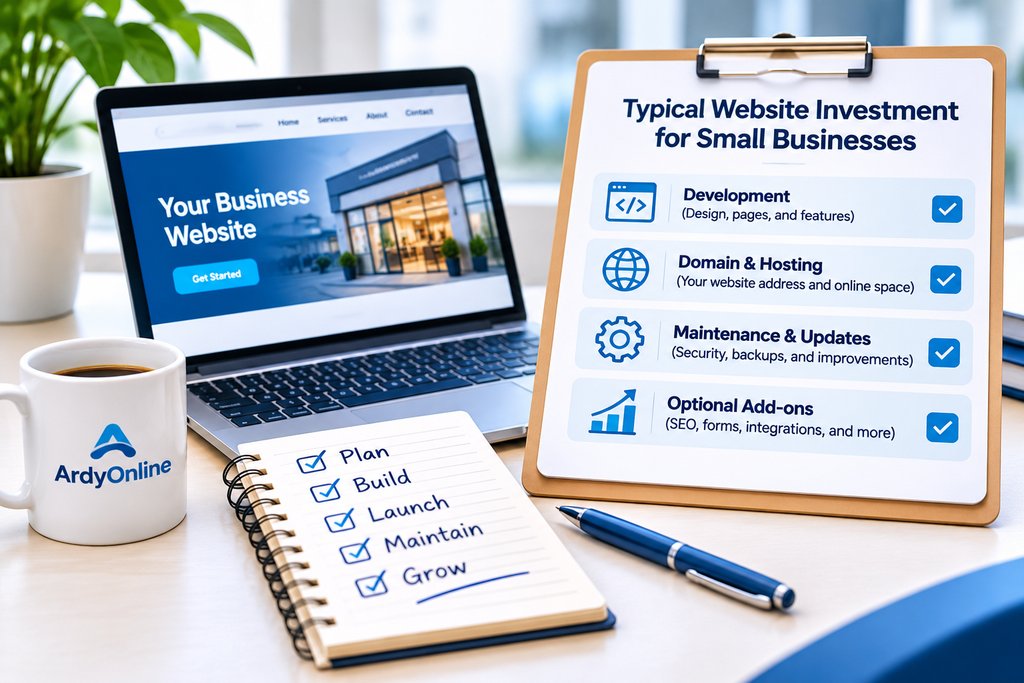
A practical website investment framework
Instead of evaluating only the development quotation, consider the following:
| Investment Component | Cost Structure |
|---|---|
| Website planning and development | Typically project-based |
| Domain registration | Usually annual |
| Website hosting | Monthly or annual |
| Website maintenance | Recurring, depending on scope |
| Technical support | Retainer or usage-based |
| Future enhancements | Quoted according to requirements |
A useful budgeting exercise is to estimate the total cost over three years.
This helps business owners account for recurring obligations and compare providers more fairly.
It also highlights the importance of asking which services are already included in a proposal.
A lower initial cost does not always mean a lower long-term investment.
7. Hidden Website Costs Business Owners Should Consider
Some website proposals focus primarily on design and development.
However, additional services may be necessary depending on the project’s requirements.
Potential expenses include professional copywriting, product photography, premium software licenses, search engine optimization campaigns, payment processing, business email, and third-party integrations.
Businesses should also confirm whether website changes, additional revisions, migration assistance, and future technical support are included.
Another important consideration is ownership.
Before approving a project, understand who will control the domain, website content, hosting account, and relevant administrative credentials.
A professional development agreement should clearly explain deliverables, payment milestones, ownership arrangements, limitations, and post-launch responsibilities.
Search engine optimization is another consideration. Google’s SEO Starter Guide explains the foundational practices that help search engines discover and understand website content. More advanced SEO work may require a separate ongoing investment.
These details can help prevent misunderstandings and unexpected expenses.
8. Choosing the Right Website Development Partner
Selecting a website provider should involve more than comparing advertised prices.
A reliable development partner should understand your business goals and recommend solutions aligned with your requirements.
Evaluate the provider’s portfolio, development process, communication practices, technical capabilities, and ongoing support arrangements.
You should also ask whether the provider can explain why particular features or services are being recommended.
For example, a newly established consulting business may not immediately require a custom customer portal.
A professionally designed informational website with effective inquiry forms may provide a more practical starting point.
Advanced functionality can be considered later when justified by actual business needs.
The objective is to invest in a website that supports your current operations while allowing room for future growth.
The right website investment is not necessarily the cheapest or most expensive. It is the one that best fits your business objectives.
Frequently Asked Questions
Can I build a business website for free?
Yes. Some platforms offer free website-building options, although these may have limitations involving customization, branding, hosting, and functionality.
Businesses should also consider the time required to build and manage the website.
Is WordPress suitable for professional business websites?
Yes. WordPress is widely used for business websites, blogs, and online stores.
Its suitability depends on the project’s requirements, technical configuration, maintenance arrangements, and development approach.
Does website development include SEO?
Some professional website projects include foundational SEO configuration, such as page titles, meta descriptions, website structure, and mobile optimization.
Ongoing SEO campaigns, keyword research, and content marketing may be provided separately.
How much does ArdyOnline charge for website development?
ArdyOnline provides customized website development quotations based on each client’s specific requirements.
Pricing depends on project scope, design complexity, functionality, technical integrations, and other agreed deliverables.
We recommend discussing your business objectives first so we can identify a suitable solution and provide a clear quotation.
Does ArdyOnline offer hosting and website maintenance?
Yes. ArdyOnline offers website hosting, website care, technical support, and related digital solutions.
Service recommendations and pricing are tailored to the requirements of each client.
Final Thoughts: Your Website Is a Long-Term Business Investment
A professional business website should do more than establish an online presence.
It should clearly communicate your services, strengthen customer confidence, and provide practical ways for visitors to connect with your business.
Before investing, take time to understand the development process, essential features, ongoing expenses, and long-term responsibilities involved.
You do not necessarily need the most advanced website available.
What matters is choosing a solution that meets your current requirements and provides a reliable foundation for future growth.
Planning a New Website or Improving Your Existing One?
At ArdyOnline, we help businesses establish and strengthen their online presence through professional website development, hosting, website care, technical support, and practical digital solutions.
We understand that every business has different objectives, requirements, and priorities.
That’s why our recommendations are tailored to each client’s needs rather than relying on a one-size-fits-all approach.
Let’s discuss your business goals and explore a website solution that fits your requirements.
Visit ArdyOnline.com to connect with our team.